In the new Jerusalem there is a hill called Katamonas, the name of which is traced back to the Greek “Kata- monas” (towards the Monastery) because it was located far from the centre of the city. This hill was identified according to the folklore, on the place of burial of the Just Symeon the Theodohos (God receiver). Symeon the Theodohos was a just and pious man, and one of the seventy translators of the Holy Bible, who was sent together with others to Alexandria after the request of Ptolemey the Philadelphos (brotherly love). There, translating the Holy Bible from the Jewish language to the Greek language, turned his attention to the passage of the prophet Isaiah: “Here is the Virgin who is with child and who will bear a son and he will call his name Emmanuel”. This passage disturbed the intellect of the pious Symeon, who was overcome by many thoughts of disbelief. For this reason he threw his ring into the river saying that if he would find it again, he would believe the things written by the prophet. According to tradition after he stayed overnight at a small town, he bought a fish to eat with his companions, he found his ring in the belly of the fish. Then his thoughts were cleared of any doubts and he followed the road to Jerusalem and lived there. According to the Old Testament, Symeon the Just, knowing of the coming of the Messiah, entreated God to make him worthy to sees Him before his death; “not see death before he sees Christ before his death”. His prayer was heard and it was he
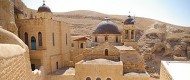
 who received the Most holy Theotokos with the divine infant at the Temple saying; “Now let Your servant depart in peace, according to Your word…..” (Luke 2:25-32). Having seen the salvation of God “which He prepared in person for all people” he blessed the parents of the child, the saint and Just Symeon immediately reposed in the Lord at an age of 270 years and was buried in his tomb. Concerning his holy relics, they were transferred during the construction to the holy church which was built in Constantinople by the emperor Justinian in the name of the Saint James the brother of God. According to tradition on the hill was located the house of the just and pious Symeon. In his garden were also the tombs of his family as was the custom of the Jews and the early people of Egypt, of Palestine and of Syria. In the 12th century the first monastery and Church were built on the hill of Katamonas by the Iberian monks who constructed over the early ruins of Katamonas the holy church with the name of Saint Symeon the God receiver. Later they became ruins and many centuries later, on the 19th century monk Avramios from Medyton, bought the ruins with quite a large area of the Katamonas Monastery. The industrious and lover of beauty monk, toiled hard for twenty one years to reconstruct the Holy Church and the bethel building. He also built a kitchen, storage rooms and tilled a garden. In 1879 Avramios was guided by an early tradition and examined with extreme diligence the front yard of the early tower to discover the tomb of the Saint. And in fact while excavating, he found the tombs carved inside a rock. However, because they were full of rocks and dirt, he cleaned them and enlarged the entrance. These tombs even though they were outside the tower have been included within it by an additional wall and a church was built with the name of Saint Symeon within which are also the tombs. Inside the church, today the pilgrim can see carved stones from the early building, the different underground cisterns around the building and many sections
  of the ground which was laid with mosaics, indications of magnificent buildings which were built during the Christian era. On the iconostasis there are three icons of which one depicts the saint and just Symeon translating the “Here is the Virgin that carries in her belly and will bear a son”, the other one depicts the God-receiver casting his ring into the river and the third finding it in the belly of the fish. The ground of the whole Church is tiled with reddish white marble while the ground of the Chapel is paved and is connected with the rock at the end of which are the tombs. The Church service of Saint Symeon: “Oh peculiar miracle, the giver of law, submitted to the law, and now fulfilling the law, to the temple is offered, elderly hands are stretched to the Most Holy Virgin mother, taking Him into his bosom, Symeon requests to be loosed, crying. My eyes have seen Your salvation, grafted to us by the Holy Spirit. Today the heavenly gates are opening to us for the Lord of all, Son and Word of God, assuming leadership in due course, as infant in the temple, by a mother who knew of no man was brought in and into elder hands, the elder Symeon receives Him, crying. Now set me free. For I have seen the Despota, the life of all, and the salvation of Your people…”